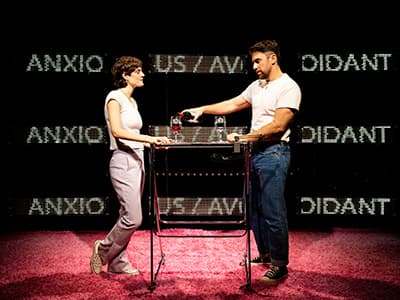
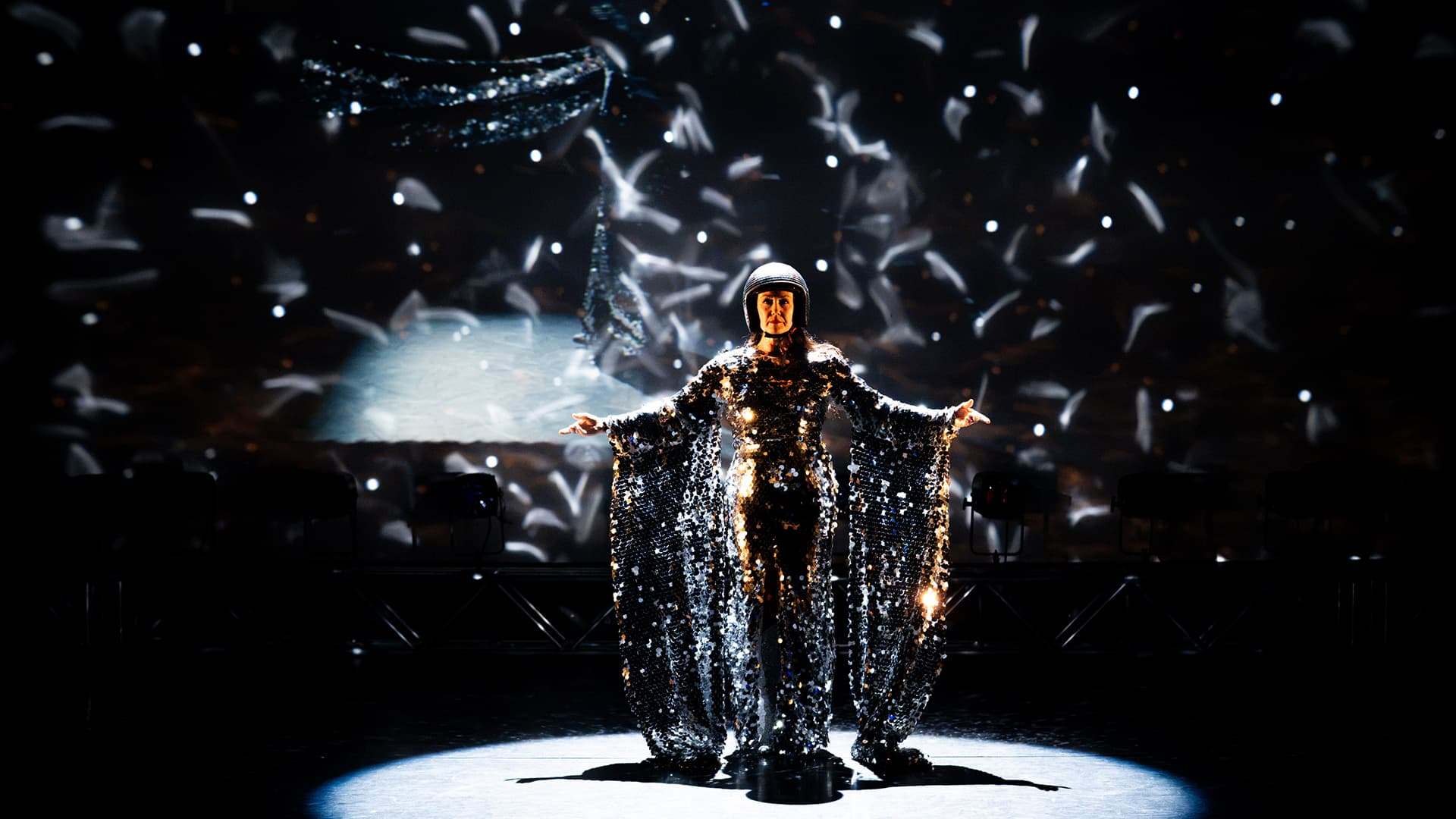

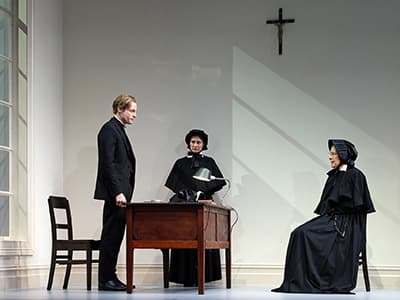
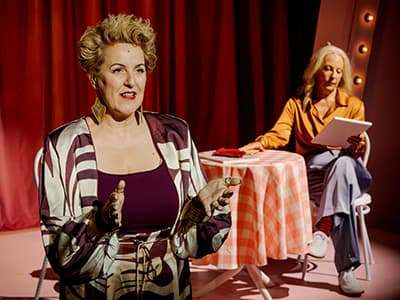
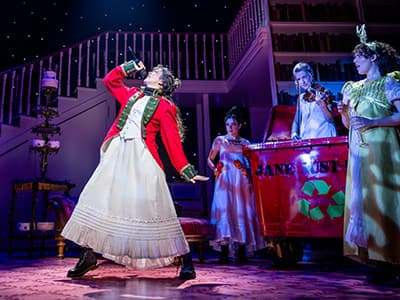
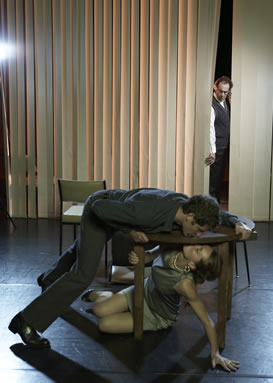
 Left: (l-r) Vincent Crowley, Stephanie Lake, Brain Lipson. Cover: Brian Lipson and Cast. Photos: Chris Budgeon
The life of an actor and dancer is based on duplicity. There is an on-stage and an off-stage, a time in disguise and a time when the costume comes off. Gideon Obarzanek,Co-Director/Choreographer with Lucy Guerin of Chunky Move’s Two Faced Bastard, describes it as a ‘two faced’ job. It is this duplicity that Two Faced Bastard demonstrates and challenges. Through its combination of modern dance, abstract movement and acting, it proves that while there is always a different point of view, a different opinion, a different side, trying to make a distinction between them can result in a wonderful mixture of harmony and utter chaos but may ultimately be futile.
In the words of the usher “it’s the same, but different”. He refers to the show the audience will view if they enter the performance space through his door, rather than the other. Which door the audience enter, is the first of two choices they must make when viewing this production. For the audience, these decisions will determine not just their viewpoint but also the very show they experience. It must be noted, that the descriptions of this particular audience member will most certainly differ to those of anyone who entered the other door.
The floor to ceiling vertical blinds are a rather ingenious choice by set designer Ralph Myers and largely contribute to the split nature of this production. They physically divide the two audiences and performance spaces and open and close to reveal a tantalising glimpse of the performance (and sounds) on the other side.
The space on one side of the blinds is best described as the front of stage, while the other side acts as backstage. The performers manoeuvre their bodies through the blinds to cross from one space to the other,but the blinds tangle and this transition between front of stage and backstage is neither easy nor clean. On this particular evening in a moment of frantic energy, one strand of blind is torn down. The apparent division between performer and audience, on stage and off stage, is never a certainty.
In this production the very process of creation and transformation is there for all to see. Both sides of the blinds exist in front of an audience so that in reality the performers are never off stage, nor out of character. They dress in front of the audience, they call each other by their real names, and they even discuss their art and what they expect of their audience. The issues discussed in the forum open up possible interpretations of the hour that follows but also provide some very comic moments, particularly from Brian Lipson.
As an ensemble the performers show great chemistry and trust. The dancers, Stephanie Lake, Byron Perry, Antony Hamilton and Michelle Heaven, all display great energy and consideration of their movements. Perry and Hamilton’s extreme physicality and synchronicity is particularly impressive. It would appear that one audience is treated to less dance time than the other, and in particular seems to miss out on a solo by Lake. If her performance at the end of the production is any indication it would have been rather special.
Amidst all of this Vincent Crowley does well as the voice of reason and the only ‘non-performer’. For a long time his character is the one who does not traverse the two spaces and can consequently separate on and off stage and what is creation and reality. But, tempted by Steph, who belongs on the other side, on stage, he can only avoid this for so long.
Perhaps the most amusing and creative moment in this production also questions what it means for a character and a creation to crossover from the stage to a space that is considered to be real life. A tiny,white, bird-like character enters back stage through the blinds. At first she tentatively plays with the polystyrene that litters the floor but she soon gets cheekier and louder. It is Michelle,dressed from head to toe in a costume made of cardboard and sheets, which to costume designer Paula Levis’ credit, accentuates rather than hinders Michelle’s movements. Nevertheless, Vince cannot accept the notion that the character and the performer are the same person and that a space can exist in which the two combine.
Unfortunately only one audience views the antics of the little white bird in its entirety and it is therefore possible that one audience misses out on a most important part of this production. At one stage the blinds are opened completely and the audience is given the option to swap sides, to see what the other audience sees. They must make their second choice for the evening and it is then that a curious tug of war begins between wondering what will happen if the point of view is shifted. Will we miss out or will it be better?
The wonderful thing about Two Faced Bastard is that regardless of which door you enter, it is guaranteed that you will be shown, without disguise, many wonderful faces.
Chunky Move & Melbourne International Arts Festival present
TWO FACED BASTARD
Venue: Arts House Meat Market
Dates: Wednesday 8 to Sunday 12 October
Bookings: Ticketmaster 1300 136 166 or www.melbournefestival.com.au
The cast is exceptional. The choreography is precise and beautifully executed. The lighting is gorgeous. The whole thing moves with extraordinary confidence and energy.
16 August 2026
Canberra
11 August 2026
Melbourne
8 August 2026
Canberra
Latest Reviews
Two Faced Bastard | Chunky Move
- Details